If someone has sent you an invite link to ENC, a “global green energy platform” at app.encfunds.app, read this before you deposit a cent. It looks like a slick solar investment app. Underneath, it works like the USDT “click-a-button” schemes that have already cost people around the world a lot of money.
We pulled the app apart, checked who registered it and when, and went looking for the company it says it belongs to. Here's what we found, in plain language.
🔑 Key Takeaway
ENC promises fixed daily returns, accepts only crypto, pays members for recruiting, makes withdrawals hard, and claims a parent company we couldn't find. We rate it very high risk: it shows every red flag of a Ponzi or pyramid scheme.
What Is ENC?
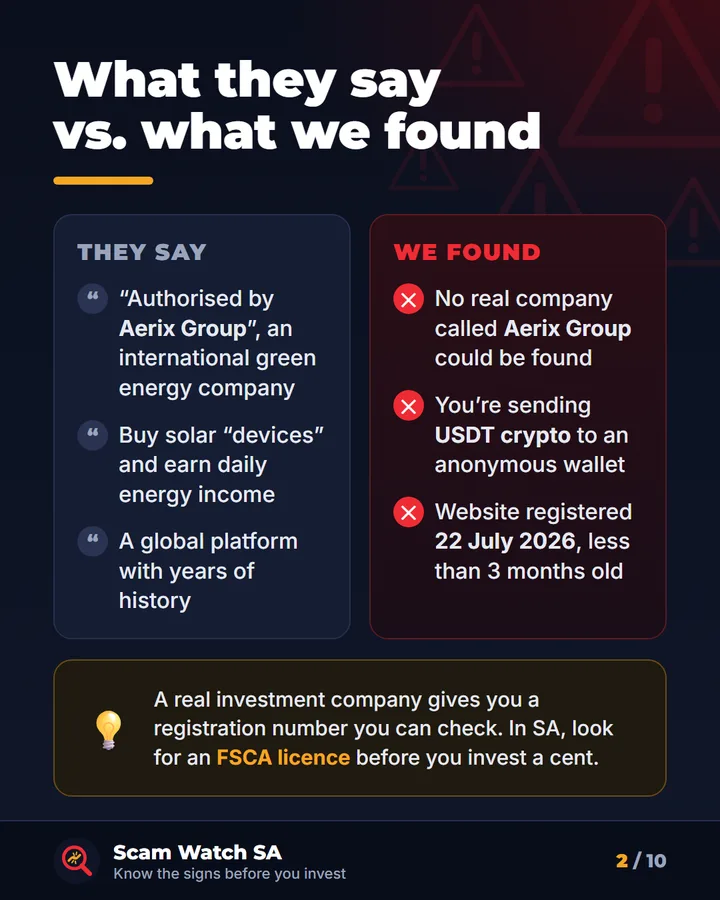
ENC presents itself as an online green energy business. You “buy” solar, photovoltaic or energy storage “devices” inside the app, and each device pays you a daily income. A second website, enchope.com, plays the role of the corporate homepage. It describes ENC as the “Aerix Group authorised” online platform, complete with a group history, business areas and an “Authorisation” section.
The app is built for an international audience. It's available in more than ten languages, but its base language and its server messages are Chinese. You can use it in the browser or download an Android app file (ENC.apk) directly from the site.
How We Checked It
We only looked at what's publicly visible. We didn't create an account, deposit anything or install the app. That covered three things:
- The app's code. Everything a web app shows you, from menu labels to fee rules, ships to your browser. We read the screens, rules and wording built into it.
- Domain and certificate records. These are public registers that show when a website was created and when its security certificates were issued.
- The company claims. We searched for “Aerix Group” and for any reporting or regulator warnings about ENC.
You don't have to take our word for it. Anyone can repeat the domain and certificate checks for free: look up a website's registration on rdap.org and its certificate history on crt.sh. Every source we used is listed in Sources and Further Reading at the end of this article.
The 7 Red Flags
1. A fixed “daily rate” on your money
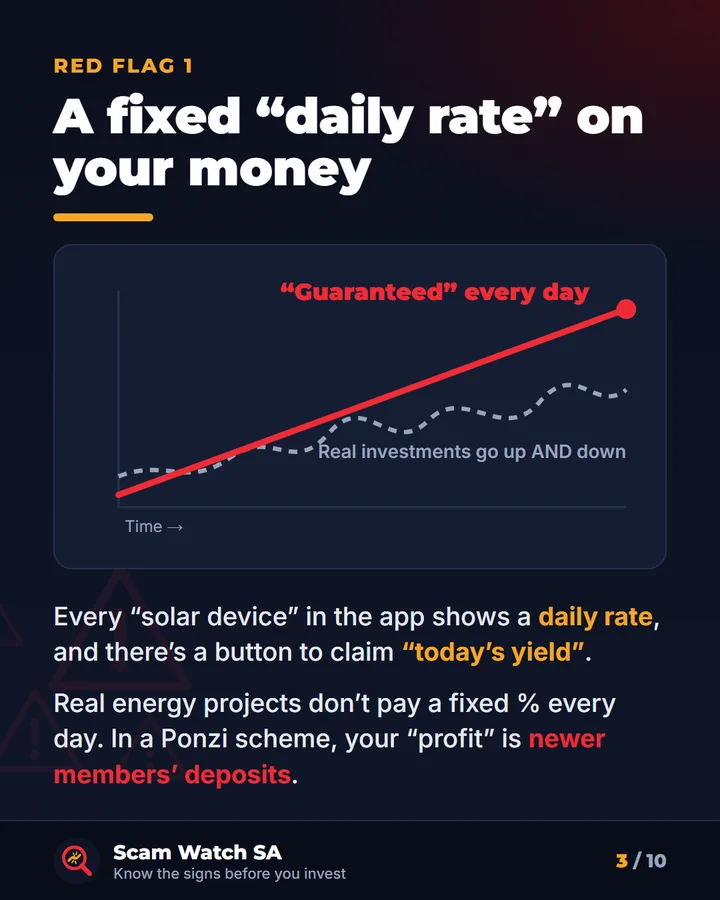
Every “device” in the app shows a daily rate, and the dashboard has a button to claim “today's yield”. Real solar projects don't work like that. Their income depends on weather, electricity prices, maintenance and debt, so it goes up and down.
A return that arrives like clockwork every day is the signature of a Ponzi scheme. Early members get paid with money from newer members, which looks like profit until new deposits slow down.
2. Crypto only, approved by screenshot
You can only deposit USDT, or BTC, ETH and BNB that the app converts to USDT. You send it to a wallet address, upload a screenshot as “proof”, and then the app tells you: “Deposit submitted. Please wait for review.” Someone behind the scenes decides whether your money counts.
There's no bank, card or registered payment company involved, which means nobody you can dispute the payment with. Once crypto leaves your wallet, it can't be reversed.
3. The real money is in recruiting
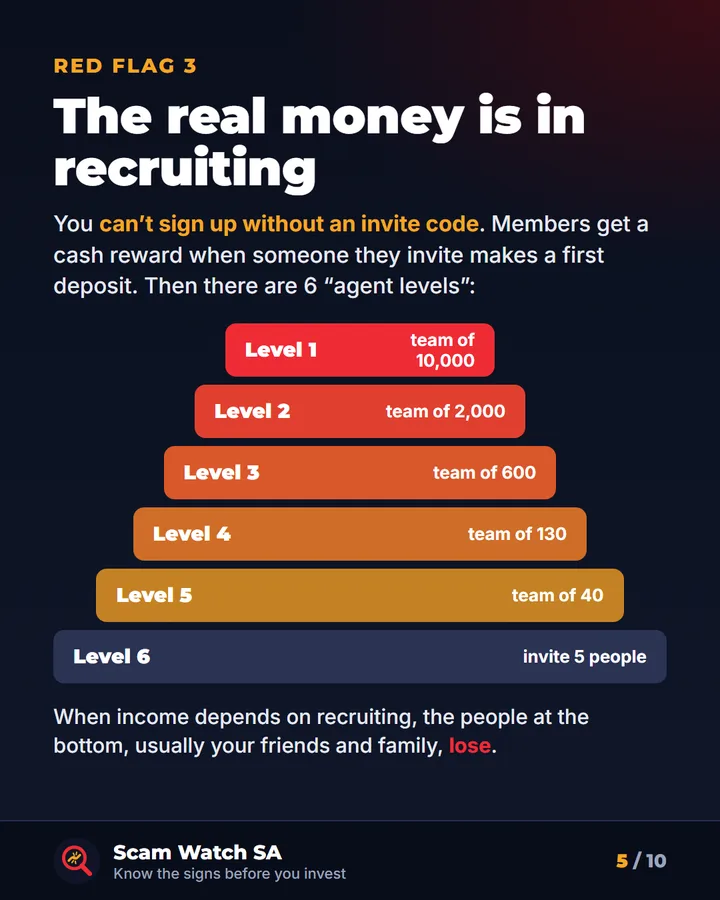
You can't open an account without an invite code. The sign-up form literally says “Enter invitation code (required)”. Members earn a reward when someone they invited makes a first deposit, and there are six “agent levels”:
| Level | What the app says you need |
|---|---|
| Level 6 | Invite 5 members |
| Level 5 | 2 Level 6 agents, team of 40 |
| Level 4 | 2 Level 5 agents, team of 130 |
| Level 3 | 2 Level 4 agents, team of 600 |
| Level 2 | 2 Level 3 agents, team of 2,000 |
| Level 1 | 2 Level 2 agents, team of 10,000 |
When income depends on bringing in new people, the maths only works for the people near the top. Everyone who joins late, usually friends and family of earlier members, is the one who loses.
4. Easy to put in, hard to take out
Depositing takes a screenshot. Withdrawing takes a lot more:
- ID verification before any withdrawal
- A separate “trade password” you have to set up first
- A withdrawal fee and a minimum withdrawal amount
- A manual review before anything is paid
On top of that, the app's own rules say that if you end a “device” early you only get back 80% of your principal. Put in 100 USDT, leave early, and you get 80 USDT back. Schemes like this often pay out small withdrawals at first to build trust, then add new fees, “taxes” or delays once larger amounts are involved.
Never pay to unlock a withdrawal
If you're told to pay a “fee”, “tax” or “verification deposit” before you can withdraw, stop. That's usually the last payment a scheme takes before it disappears.
5. Brand new websites, set up together
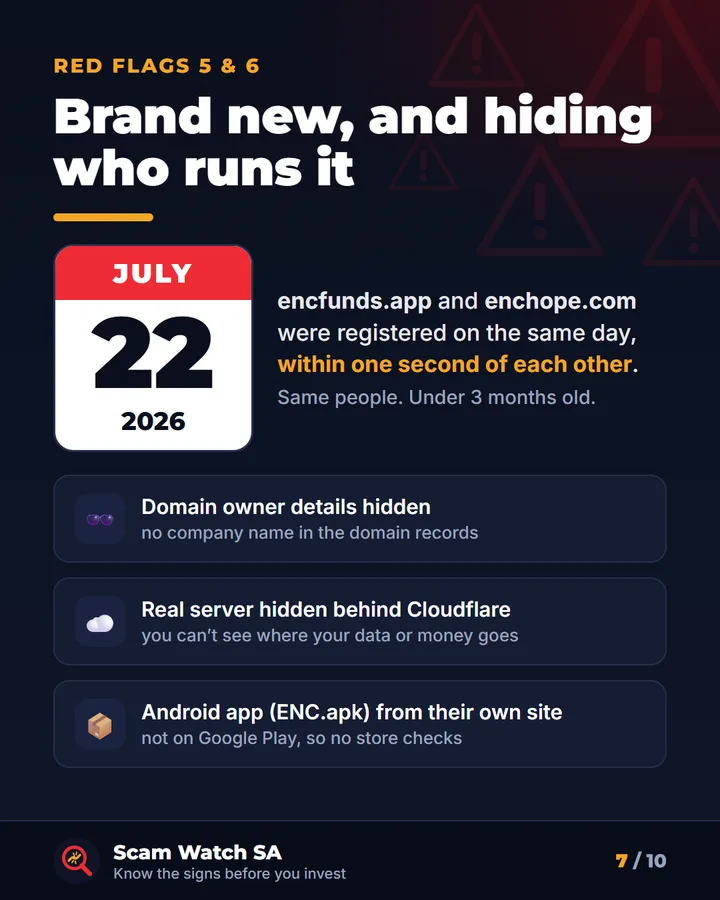
Public domain records show that enchope.com was registered at 05:19:14 UTC on 22 July 2026. The one-year registration for encfunds.app expires at 05:19:15 on 22 July 2027, one second after enchope.com's. In other words, both domains were set up together, by the same person, within a second of each other. The first security certificates for the app, its API and an admin panel were issued two days later, on 24 July.
So the “global platform” with a group history was less than three months old when we checked it.
6. Hidden owners and an off-store app
The domain records don't name any company or owner. The site sits behind Cloudflare, a legitimate service that also hides where the real server is. And the Android app is a file you download straight from their website (ENC.apk, version 1.0.15 when we checked), not something that's been through Google Play's checks.
None of these on their own prove anything. Together with everything else, they mean that if things go wrong there's no one you can identify, contact or hold responsible.
7. A “live feed” built to make you rush
The app scrolls messages about rewards other members are supposedly earning, in the format “Friend X's first deposit of Y USDT earned you a Z USDT reward”. There's also an “invite lottery”. You have no way to check any of it. Its job is to create fear of missing out, so you deposit before you've thought it through.
The “Aerix Group” Story
enchope.com describes Aerix Group as an international group working in solar power, distributed photovoltaics and energy storage. We couldn't find any real company by that name. The closest real businesses have similar-sounding names, such as Aerem Group in India, Enerix in Europe and Energix Renewables. “ENC” is also the stock ticker of ENCE Energía y Celulosa, a real Spanish company with no known link to this app.
Borrowing the look and feel of a real energy company is a well-documented trick. BehindMLM has covered near-identical USDT apps that used the names of Engie and Enel Green Power, with fixed daily returns and recruitment commissions just like ENC. (BehindMLM doesn't open in every country. If it's blocked for you, here's an archived copy of the Enel review.)
When we checked, we found no news coverage or regulator warning that names ENC specifically. That's normal for a scheme this new. A clean search result doesn't mean something is safe.
🔑 Check any “investment” in South Africa
Anyone giving financial advice or selling financial products in SA must be authorised by the Financial Sector Conduct Authority. Search for the company on the FSCA website before you invest. If you can't find a licence, don't invest.
What to Do Now
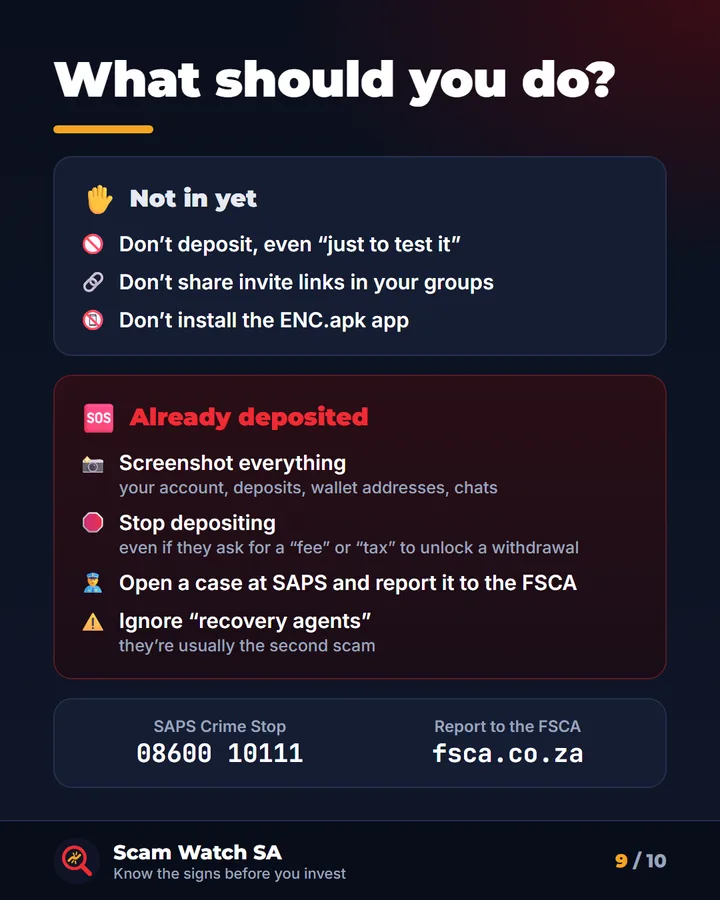
If you haven't joined: don't
Don't deposit “just to test it”, don't forward invite links to your groups, and don't install the ENC.apk file.
If you've deposited: save the evidence
Screenshot your account, balances, deposit history, the wallet addresses you paid and any chats with whoever recruited you. These sites can vanish overnight.
Stop sending money
Even if your balance looks healthy, and especially if you're asked to pay something to unlock a withdrawal.
Ignore “recovery” offers
People who lose money to schemes like this are often contacted by “recovery agents” who want a fee upfront. That's usually a second scam.
For the bigger picture on how fake crypto platforms work, read our guide to crypto and investment scams in South Africa.
FAQ
Based on what we found, we rate it very high risk. It promises fixed daily returns, only accepts crypto, pays members for recruiting, makes withdrawals difficult and claims a parent company we could not find. Those are the core features of a Ponzi or pyramid scheme.
ENC says it is authorised by Aerix Group. We could not find any real green energy company with that name. ENC is also the stock ticker of the Spanish company ENCE Energía y Celulosa, which has no known link to this app.
Crypto transfers can't be reversed, so recovery is difficult. Stop depositing, screenshot your account, deposits and the wallet addresses you paid, open a case with SAPS and report the platform to the FSCA. If you bought the crypto on a South African exchange, report the destination wallet to that exchange too.
No. Asking for more money to unlock a withdrawal is one of the most common ways these schemes take a final payment from victims before disappearing. Stop depositing and report it.
Almost certainly not. Recovery scams target people who have already lost money, often using the same groups and contact lists. Real law enforcement and regulators don't charge you to investigate.
Conclusion
ENC wraps a familiar scheme in a green energy story: fixed daily returns, crypto-only deposits, rewards for recruiting, fees and penalties on the way out, and a parent company that doesn't appear to exist. When we checked, it was less than three months old.
The name will change. ENC may well be gone in a few months and replaced by something with a new logo and the same rules. The red flags won't change, so learn them and share them with the people in your group chats who are most likely to get an invite.
🛡️ The 7-Sign Checklist
- Fixed daily returns
- Crypto-only deposits, approved by hand
- Invite code needed, plus rewards for recruiting
- Fees and penalties to take money out
- Website only a few months old
- A “parent company” you can't find anywhere
- An app you install outside the Play Store
This article is based on our review of the public ENC website, app code and domain records on 15 October 2026. It's a risk assessment, not legal or financial advice. If you represent ENC and believe something here is wrong, contact us with evidence and we'll review it.
🛡️ Learn the Pattern, Not Just the Name
Our crypto scam guide covers pig butchering, fake trading platforms and the warning signs they all share.
Read the Crypto Scam Guide →Sources and Further Reading
Our own checks were done on 15 October 2026 and can be repeated using the public records below. The app quotes (for example “Deposit submitted. Please wait for review.” and “Enter invitation code (required)”) come from the text built into the ENC web app on that date.
Records you can check yourself
- enchope.com domain registration record (RDAP): registration date and time
- encfunds.app domain registration record (RDAP): expiry date and time
- encfunds.app certificate history (crt.sh): when the app, API and admin certificates were issued
Reporting on similar schemes
Where to check or report
- Financial Sector Conduct Authority (FSCA): check whether a company is authorised, and report unauthorised schemes
- South African Police Service (SAPS): open a case
- ENCE Energía y Celulosa: the real company behind the “ENC” ticker, for comparison
More from TechCruze
- Crypto & investment scams in South Africa: how fake trading platforms work
- Real or fake bank SMS & email checker