⚡ Quick Answer: Why do pyramid scheme members recruit so hard?
Because a pyramid scheme has no real income. The only money coming in is new members' deposits. The people already inside need you to join so their commissions and “profits” can be paid, and so they can get their own money out before it collapses. When new people stop joining, the last ones in lose everything.
You've probably seen it: a friend of a friend posting screenshots of daily “profits”, a WhatsApp group full of voice notes about financial freedom, a stranger in your inbox who just wants to “share an opportunity”. They seem so sure. Why are they so desperate for you to join?
This article explains, without jargon, how the money in a pyramid scheme actually moves, why the people inside need you, and why the strangers recruiting you online will never see what happens to you when it all falls apart.
How Does a Pyramid Scheme Really Make Money?
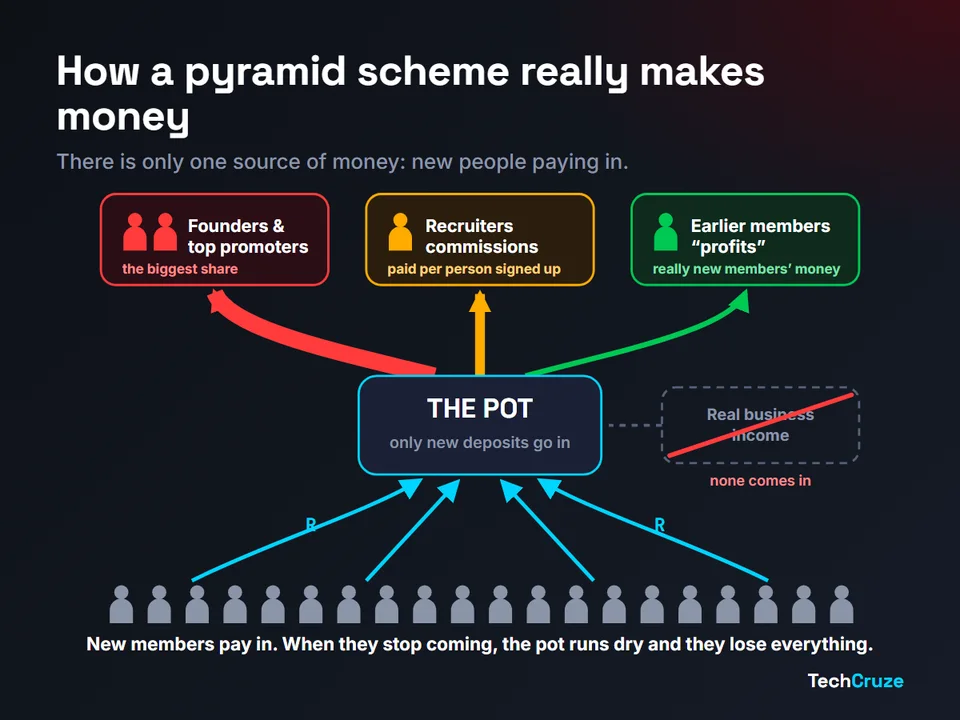
A pyramid scheme dresses itself up as something real: crypto trading, solar “devices”, forestry, forex, a “stokvel”. But underneath, there's only one source of money: new people paying in. There's no real business earning anything.
That money goes into one pot, and it flows out in three directions:
- Founders and top promoters take the biggest share.
- Recruiters get paid commissions for every person they sign up.
- Earlier members get “profits”, which are really just newer members' deposits being passed up the line.
South African law describes this pattern exactly. Under the Consumer Protection Act, a scheme is a pyramid scheme if participants are paid mainly from recruiting other people, rather than from selling real goods or services (section 43(4)).
Why Do Members Push So Hard to Recruit You?
Once you understand the pot, the pressure makes sense. People inside a pyramid scheme recruit for a few reasons, often all at once:
- Their pay depends on it. Commissions, bonuses and “levels” are all paid for bringing in new deposits. In the RNK / NT Team scheme, members say accounts were even blocked from trading if they didn't recruit.
- It's their way out. Many members know, deep down, that it can't last. Getting more people in is how they hope to get their own money out before the end.
- They've been told it's “helping”. Schemes train members to see recruiting as sharing a blessing, and to treat doubters as “negative”.
- They need it to be true. After putting in savings, it's painful to admit it might be a scam. Bringing in others feels like proof that they made the right choice.
It's important to say this clearly: many recruiters are victims too. They were recruited by someone they trusted, and they may lose money when it collapses. But that doesn't change what their recruiting does to the next person.
Why Do Recruiters Target Strangers Online?
Look at how most schemes spread today: Facebook posts, TikTok videos, WhatsApp groups with hundreds of members, influencers with big followings. The Morita Forestry scheme, which reportedly took money from more than 300,000 South Africans, relied heavily on social media influencers to bring people in (EWN).
Recruiting strangers online has one huge advantage for the recruiter: they never have to see what happens next. They don't sit at your table when the payments stop. They don't see your children go without. They block you, delete the group, and move on to the next “opportunity”, sometimes with the same followers.
What Is the Family Test?
Here's a simple question for anyone promoting a scheme, and for anyone being recruited: would you put your own mother in it?
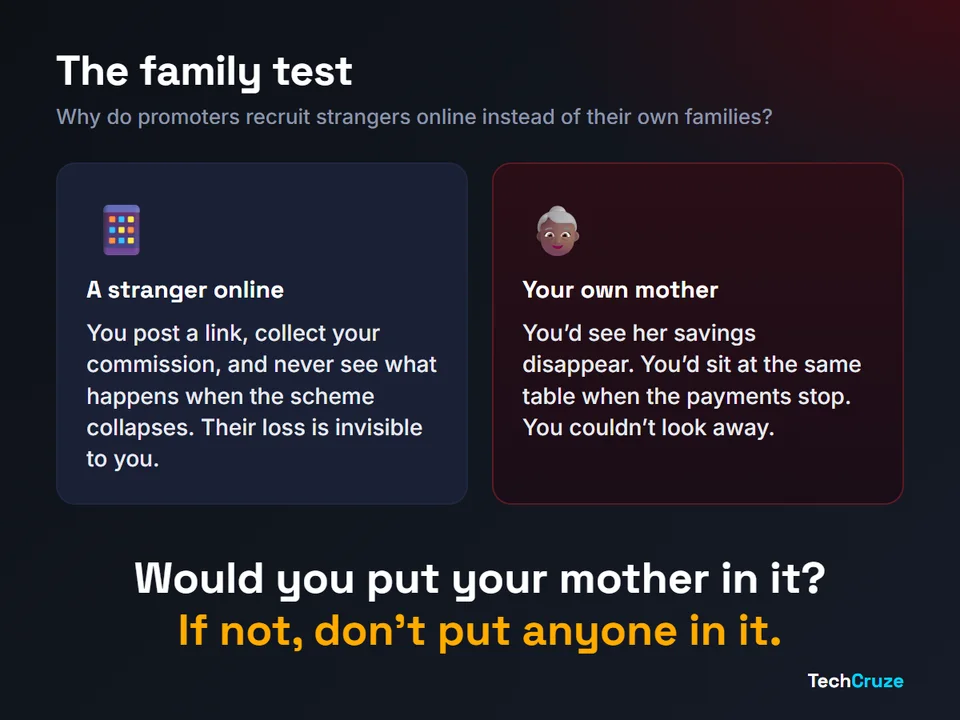
If a recruiter put their own family's savings in, they'd have to live with the result. They'd see the loss up close, and it would be much harder to do it again. The fact that so many promoters keep recruiting strangers while keeping their own families out tells you what they really believe about the scheme.
🔑 Turn the test around
If someone is recruiting you, ask them: “Is your mother in it? Your partner? Your children?” If the answer is no, or they change the subject, you have your answer. If you wouldn't put your mother in it, don't put anyone in it.
Why Does Every Pyramid Scheme Collapse?
It's not bad luck. It's maths. Imagine every member must bring in just six new people. Each level needs six times more people than the one before:
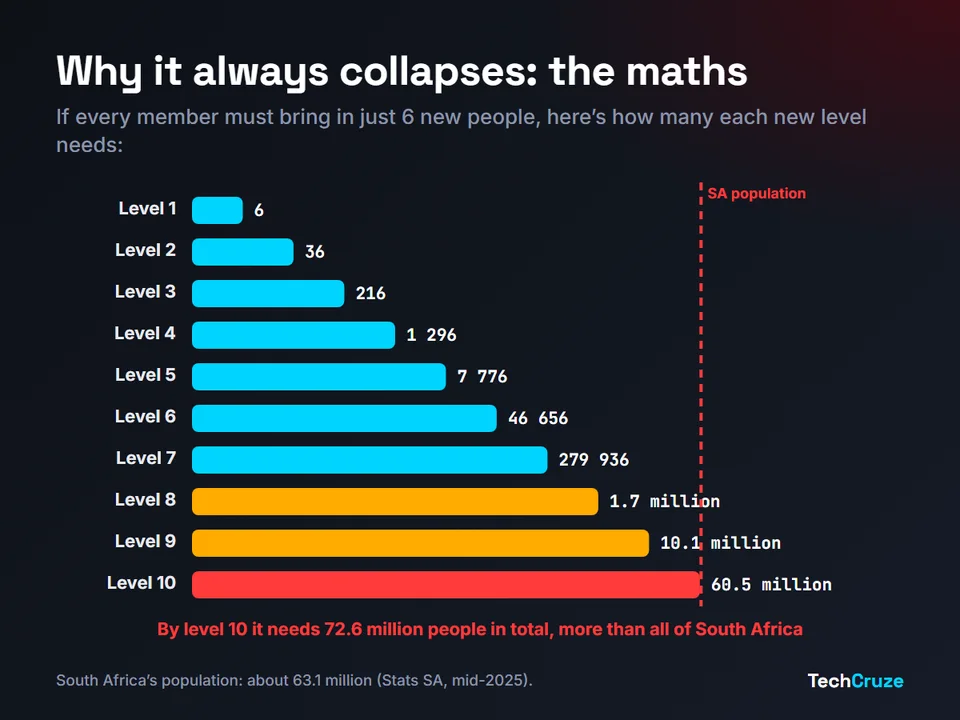
By the tenth level, the scheme needs about 72.6 million people in total. South Africa only has about 63.1 million people, babies included (Stats SA, mid-2025). Long before that point, new people stop joining, the pot runs dry, and everyone in the newest levels, which is most of the people in the scheme, loses their money.
What Does the Collapse Really Cost?
The losses aren't just numbers. When RNK and NT Team stopped paying in July 2026, investors in KwaZulu-Natal lost savings of R50,000, R100,000 and more, and some protested outside the SABC. After the Morita Forestry collapse, journalist Joel Cedras told 702 that “quite a handful of people” had taken their own lives (EWN).
And yet, after each collapse, some promoters simply move on to the next scheme. Reports after RNK's collapse said some recruiters had already launched a new “investment” and were inviting former members to join. The people who lost everything weren't their people.
If you've lost money and you're not coping
You're not stupid and you're not alone. These schemes are designed to fool careful people. Please talk to someone: SADAG's 24-hour suicide crisis helpline is 0800 567 567, or SMS 31393.
Is Recruiting for a Pyramid Scheme Illegal?
Yes. Section 43(2) of the Consumer Protection Act says a person must not “directly or indirectly promote, or knowingly join, enter or participate in” a pyramid scheme, “or cause any other person to do so” (Consumer Protection Act, s43).
That wording matters. It isn't only the founders who break the law. Promoting the scheme, and causing someone else to join, is also prohibited. Posting your referral link, running a WhatsApp group or hosting a “training session” for a pyramid scheme can all count as promoting it.
Already Recruited People? What to Do Now
Stop recruiting today
Even to try to win back what you've lost. Every new person you bring in is the next person who loses.
Be honest with the people you brought in
Tell them what you now know, and share this article. It's hard, but it may stop them depositing more.
Keep your records and report it
Save screenshots, proof of payments and chats. Report pyramid schemes to the National Consumer Commission, and investment schemes to the FSCA (0800 110 443).
Don't fall for the next one
Watch out for “recovery agents” and new schemes from the same people. Our guide to recovery scams explains how they work.
FAQ
Because a pyramid scheme has no real income. The only money coming in is new members' deposits, so the people already inside need new members to pay their commissions and “profits”, and to get their own money out before it collapses.
Yes. Section 43 of the Consumer Protection Act says a person must not directly or indirectly promote, or knowingly join or participate in, a pyramid scheme, or cause any other person to do so. That covers recruiters, not just the founders.
Because the number of new members needed grows too fast. If each member must bring in six people, the tenth level alone needs over 60 million people, and the scheme as a whole needs about 72.6 million, more than South Africa's entire population of about 63.1 million.
Stop recruiting, including to recover your own losses. Tell the people you brought in what you now know, keep your records, and report the scheme to the National Consumer Commission or the FSCA. If you're struggling, talk to someone: SADAG's suicide crisis helpline is 0800 567 567.
In a stokvel, members you know contribute and take turns receiving or sharing the money, with no promised returns from recruiting. In a pyramid scheme, your income depends mainly on bringing in new people, and the last people in lose.
Conclusion
A pyramid scheme is a machine that turns new people's savings into earlier people's “profits”. The people inside need you to join because you are the income. And the further away you are from the recruiter, a stranger on Facebook or a follower on TikTok, the easier it is for them to look away when it collapses.
So use the family test. If they wouldn't put their own mother in it, don't put yourself in it. And if you wouldn't put your mother in it, don't put anyone in it.
🛡️ Pyramid Scheme Checklist
- Your “profit” depends on new people joining
- You earn more for recruiting than for anything real
- You're pushed to recruit strangers online
- The promoter's own family isn't in it
- You must pay more to withdraw, or wait for “new dates”
This article explains how pyramid schemes work in general and isn't legal or financial advice. Details about specific schemes come from the news reports linked below.
Sources and Further Reading
- Consumer Protection Act 68 of 2008, section 43: Pyramid and related schemes
- EWN: Victims of Morita Forestry scam took their own lives after losing money (4 August 2026)
- Stats SA: Inside the numbers, SA population trends for 2025
- National Consumer Commission and Financial Sector Conduct Authority
- SADAG: South African Depression and Anxiety Group